
Module #3: What is NRC and why does it matter?
Module #3
What is NRC and why does it matter?
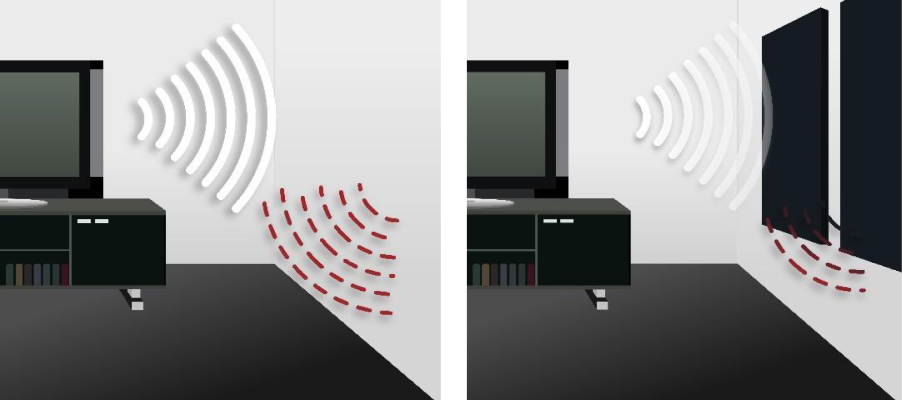
When it comes to sound absorption, different materials have varying abilities to absorb sounds of different frequencies. Low frequency sounds have longer wavelengths and require thicker and denser materials to absorb them, while high frequency sounds have shorter wavelengths and can be absorbed by lighter and more porous materials.
| MATERIAL | NRC Value |
|---|---|
| Wall Surfaces: | |
| Brick, Concrete, Marble, or Glazed tile | 0.00-0.05 |
| Concrete Block/CMU (painted) | 0.05 |
| Drywall/Gypsum/Plaster | 0.05 |
| Wood Paneling | 0.05-0.15 |
| Plywood | 0.10 |
| Drywall | 0.15 |
| Concrete Block/CMU (unpainted) | 0.35 |
| Floors: | |
| Concrete (smooth painted), Glazed tile | 0.00-0.05 |
| Resilient floor tiles | 0.03-0.05 |
| Rubber on concrete, or Linoleum | 0.05 |
| Wood on concrete | 0.06 |
| Wood on wood substrate | 0.09 |
| Cork tiles (3/4”) | 0.10-0.15 |
| Carpet (44oz/0.25 pile; loop) | 0.30 |
| Carpet (43oz/0.5 Pile; cut wool) | 0.55 |
| Fabric (draped to half area) | |
| Light Velour (10 oz/yd) | 0.14 |
| Medium Velour (14 oz/yd) | 0.56 |
| Heavy Velour (18 oz/yd) | 0.58 |
| Acoustic Products: | |
| Cork wall tiles (1/6” solid) | 0.10 |
| Molded 3d cork tiles | 0.30 |
| Perforated wood panel | 0.40-0.80 |
| Mineral fiber ceiling tile (standard) | 0.50-0.55 |
| Fabric-wrapped panels | 0.50-0.90 |
| Fiberglass ceiling tile | 0.55-0.95 |
| Acoustifoam flat panel (1”) | 0.65 |
| Perforated cork panels (molded/3d) | 0.70-0.80 |
| Acoustifoam ceiling tile | 0.90-1.00 |
| Acoustifoam flat panel (2”) | 1.00 |
| Seating: | |
| Wood/metal (unoccupied) | 0.30 |
| Leather (unoccupied) | 0.50 |
| Fabric (unoccupied) | 0.60 |
| Occupied (person in) | 0.80-0.85 |
| Note: NRC values listed are a culmination of multiple testing reports and sources, and though intended to be completely accurate, they should be used as approximate and as trend data |
|
To better understand the concept of sound absorption, imagine a sound wave as a series of peaks and valleys that move through the air. When the wave encounters a material, some of the energy is absorbed by the material, and the rest is reflected or transmitted through it. The amount of energy that is absorbed depends on the properties of the material, including its density, porosity, and thickness.
Materials that are good at absorbing low frequency sounds tend to be denser and thicker, such as concrete, brick, or heavy curtains. These materials can absorb the energy of the longer sound waves, reducing the amount of sound that is transmitted through them. On the other hand, materials that are good at absorbing high frequency sounds tend to be lighter and more porous, such as fiberglass, foam, or fabric. These materials can trap the shorter sound waves in their tiny air pockets, dissipating the energy and reducing the amount of sound that is reflected or transmitted.
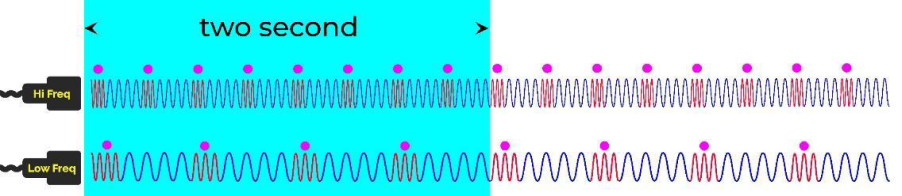
Low frequency sounds can be more difficult to absorb than high frequency sounds, as their long wavelengths require more space and specialized materials to effectively reduce their energy.
Low frequency sounds take longer to travel
- Bass traps: specifically designed to absorb low frequency sound waves by using dense materials and/or air gaps to create a resonant cavity, reducing the energy of low frequency sound waves, which can help to reduce room resonances and improve sound quality..
- Acoustic panels with low frequency absorption: these specific panels are typically thicker and use denser materials, such as mineral wool, to help reduce the energy of low frequency sounds
- Membrane absorbers: these use a thin, flexible membrane stretched over a frame to absorb low frequency sound waves, wherein the membrane vibrates in response to the sound waves, converting their energy into heat and reducing their volume.
- Porous absorbers: these use materials such as fiberglass or foam to absorb the low frequency sound waves, and as the membrane absorbers, these trap sound energy as it passes through them, converting it into heat and reducing the overall volume of the sound.
Here are several types of acoustic products that can help to absorb high frequency sounds:
- Acoustic foam: the open-cell structure of the acoustic foam excels in absorbing high-frequency sound waves.
- Fiberglass insulation: the dense, fibrous structure is also extremely effective at trapping and absorbing sound waves in the higher frequency range.
- Fabric-wrapped panels: these are basically rigid panels (potentially made of fiberglass) which have a fabric cover that are designed to be a decorative element.
- Perforated metal or wood panels: these panels are made with holes/perforations which allow sound waves to pass through the material, to which it then gets absorbed by the backing material which is typically fiberglass or mineral wool.
- Micro-perforated panels: these are perforated panels made with many, very small holes, which allows a consistent and smooth ‘visual’ on the outer layer, and as with the other perforated metal or wood panels, hey are backed with an absorptive substrate.
- Acoustic ceiling tiles: these are often relegated to commercial buildings, and are typically made from shaped Acoustic Foam, lightweight mineral fiber, or fiberglass.
Measuring NRC –
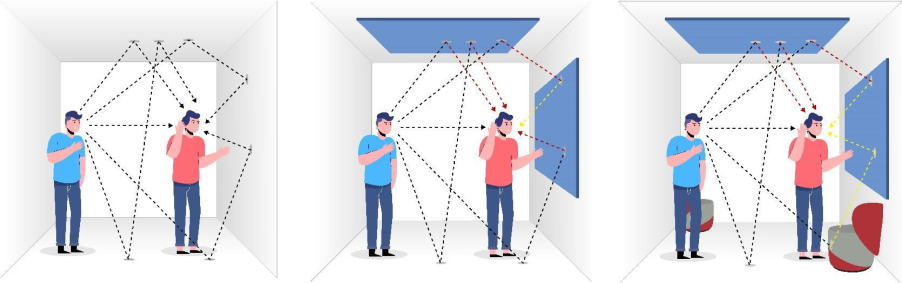
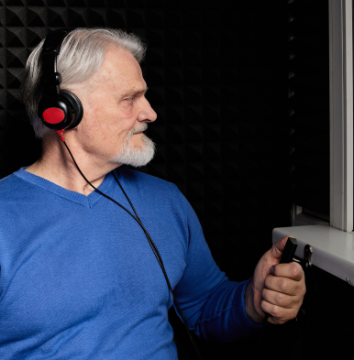
The NRC test is based on the ASTM C423 testing protocol, which has become the ‘standard’ in determining the sound absorption properties of acoustical products. Simplistically, a highly reflective room with no sound absorption is tested for its reverberation time. This becomes the baseline space, to which reverberation time is tested again once a certain amount of acoustical material is applied within the space (the amount determined by the volume of the test room). The 2 readings, one with no acoustical materials and one with acoustical material(s), are compared at a range of frequencies (typically between 100Hz and 5000Hz) to determine how much of reverberation energy is absorbed by the material being tested. Based on the total volume of the space, the total area of acoustic material, and the ‘delta’ (change) in the reverberation time as tested, the NRC can be calculated for that material. The NRC is an average of the Absorption Coefficient at 250Hz, 500Hz, 100Hz, and 2000Hz (rounded to the nearest 0.05).
As we learned in Module #1 and #2, human comfort and productivity, among other things, are directly related to how sound is heard and processed in ones’ brain. Testing has shown that there are sweet spots, or ideal decibel sound levels based on certain applications or types of spaces. Though we will analyze in greater depth the ideal conditions of certain space types (like Restaurants, Office, Schools, etc.) in some of the later Modules, it is important to design with the proper materials in mind, based on the use of that space. To do this, NRC value (and/or SAA value) is a priceless analytical tool that can help ensure there aren’t boxy sounds, too much echo, or dead spots, among other undesirable characteristics of a space. If you can dial in design with acoustics, not only will it be more pleasant to occupy the space, but there are many other psychosomatic and psychological benefits which inherently will manifest themselves
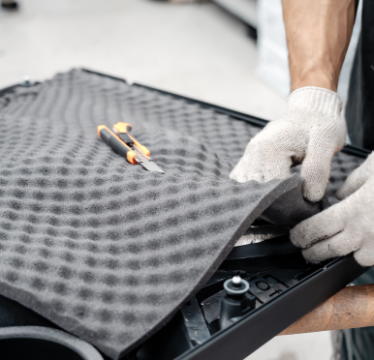
The NRC is a number that quickly provides the sound absorption properties of a certain material, which is great, but being an average of only a handful of frequencies (those considered in the human voice frequency range of sound), it doesn’t effectively portray the materials’ ability to absorb either low frequency sounds (below 200Hz) or the higher frequency ones (above 2000Hz). Though those ranges are less relevant in spaces like offices, restaurants, and hotels (as examples), NRC proves not to be hugely helpful when you either want to analyze industrial type spaces that may house machinery that produces high pitched sounds (ie: above 2000Hz) , or on the other end of the spectrum, spaces that often have sounds below the 200Hz level, like a ‘club’ (think Rave) that would be thumping a lot of ‘bass’.
Being that NRC results are limited when you analyze the data range it focuses on, there is movement to replace the test with Sound Absorption Average (SAA), which analyzes a greater range of frequencies. The SAA’s covers 200, 250, 315, 400, 500, 630, 800, 1000, 1250, 1600, 2000, and 2500 Hz, and does so with greater relative accuracy (rounding to the nearest 0.01, instead of 0.05 with NRC). This will be more helpful, in that it obviously has more data points if analyzing certain lower frequencies is helpful, but NRC will likely continue to be a main tool of analysis for years to come.
See Other MODULES:




Join Our Community of Designers and Architects
Register below for your Trade Account and get your samples for free.