
Module #5: Achieving sound comfort!
Module #5
Achieving sound comfort through design considerations
As we learned in Module #3, ideal sound levels vary based upon the type of space, and what type of activities are being done within the space (link to Module #3). And, though there are no federally mandated guidelines for space acoustics, ideal ranges of decibel levels have been developed through testing and analysis.
Download Print If the goal is sound comfort and trying to rectify spaces that are too noisy, there are common challenges faced in the process, but there are also multiple strategies that can be employed through design to either successfully build from the ground up, or retrofit, in order to achieve the often elusive acoustic comfort.
The common challenges in dealing with interior spaces that are too noisy, include:
Identifying the source of the noise: Identifying the source of the noise can be difficult, especially in complex spaces or spaces with multiple sources of noise. It may require specialized equipment and techniques, such as sound level meters (like the Noiserater App discussed in Module #3), sound mapping (which is designed to show the distribution of sound pressure in a given space), and pinpointing the source of the noise.
Limited space and budget: Improving the acoustics of a space can be costly, and in some cases, it may not be possible to make significant changes due to limited space or budget constraints. It is always recommended to consider the acoustics when designing a space, and building into the design at the beginning of the project, as without fail, it is always more economical to plan and implement, rather than try to retrofit or squeeze it in later.
Impact on aesthetics: Improving the acoustics of a space can also have an impact on the aesthetics of a space. For example, adding sound-absorbing materials to a space can make it appear cluttered or detract from the overall design of a space. Thoughtfully placed decorative acoustic treatments can help make sound absorption fit more naturally into the space (here are some cool products – link to SM front page banner, or customized landing page).Good placement
Interference with HVAC and other building systems: Improving the acoustics of a space can also interfere with other building systems, such as HVAC systems. It may require careful coordination to ensure that the acoustical improvements do not negatively impact the performance of these systems.
Occupant behavior: Occupant behavior can also contribute to the noise level in a space. For example, people talking loudly or moving around can generate a lot of noise, making it difficult to control the acoustical environment.
Compliance with codes and regulations: Improving the acoustics of a space can also require compliance with codes and regulations, such as building codes and occupational safety and health regulations. Though we noted that there are no federally mandated guidelines, some cities or municipalities may have specific requirements unto themselves. In these places, it would be advisable to consult with local experts in acoustics, architecture, and engineering to ensure that the proposed improvements comply with the noted regulations.
Though there are clearly numerous challenges in designing acoustically comfortable spaces, there are also many viable strategies and methods that can be employed to achieve sound comfort:
- Mass: Increasing the mass of a surface, such as walls or ceilings, can help reduce sound transmission. This can be achieved by adding additional layers of drywall, mass-loaded vinyl, or other materials.
- Damping: Damping involves reducing the vibration of a surface, which can help reduce the transmission of sound waves. This can be done by using materials such as viscoelastic compounds, which convert sound energy into heat.
- Decoupling: Decoupling involves separating the layers of a structure to prevent sound transmission and can be done by using resilient channels or isolation clips, which allow the layers to vibrate independently.
- Sealing: Sealing gaps and openings in walls, ceilings, and floors with acoustic sealants or specialized acoustic gaskets can help prevent sound transmission.
- Absorption: Absorption involves reducing the reflection of sound waves within a space, which can be done by using acoustic panels or other absorptive materials.
Acoustic treatment: By adding sound-absorbing materials such as acoustic panels, ceiling tiles, or carpeting to a space, it’s possible to reduce reverberation time (remember Rt60 – in Module #2) and improve the sound quality of a space.
Sound masking: By introducing a background noise into a space, it’s possible to reduce th
- White noise: White noise is a random, non-tonal sound that contains all frequencies at equal levels. It is often used in sound masking because it can effectively cover up unwanted sounds without being too distracting.
- Pink noise: Pink noise is a type of noise that has more energy in the lower frequencies than in the higher frequencies. It is often used in sound masking because it can provide a more natural and soothing sound than white noise.
- Nature sounds: Nature sounds, such as the sound of a waterfall, birdsong, or rain, can be used for sound masking to create a calming and relaxing environment.
- Music: Soft, instrumental music can be used for sound masking to provide a pleasant background sound that can help to reduce the perception of unwanted sounds.
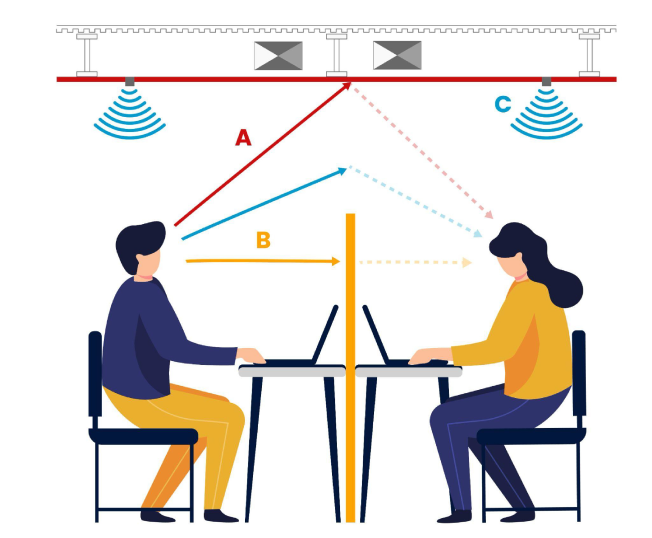
Here we show sounds within an office space. Some gets absorbed (in the ceiling panels), some can be blocked by dividers, and then through the use of Sound Masking, speakers emit sound to counter what is remaining with the space.
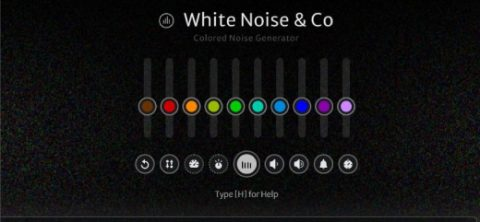
Here is a cool Noise generator that provides different types of noise, as well as sound at different frequencies.
Sound isolation: By incorporating sound-isolating construction techniques, it’s possible to reduce the amount of sound that enters or leaves a space. These methods include:
- Walls: Thick walls made of dense materials such as concrete, brick, or stone can provide a significant barrier to sound transmission. Increasing the mass and thickness of walls can help to reduce the amount of sound that passes through them
- Floors and ceilings: Floors and ceilings can also be effective noise barriers when made of dense materials such as concrete or wood, or by adding an additional layer of acoustic insulation between them. The process of ‘floating’ a floor involves decoupling the flooring from the substrate, so they are not connected. A ceiling structure can also be decoupled or separated from the structure of the building by using resilient channels or isolation clips to suspend the floor or ceiling away from the building’s structure.
- Windows and doors: Windows and doors are often the weakest points in a room’s sound barrier. Double-paned windows or laminated glass can help to reduce sound transmission through windows, while solid-core doors with weatherstripping can help to reduce sound transmission through doors.
- Seals and gaskets: Sealing gaps with acoustical sealant or specialized gaskets in walls (like windows or electrical outlets), ceilings, and floors can help to prevent sound transmission.
- Exterior noises: Placing fencing or dense vegetation between the noise source and the building can help minimize the outside sounds from entering in.

Here is a fence, a common noise barrier in residential areas.

Here is a highway noise barrier.
Room design: By designing the layout of a space to optimize the acoustical properties, it’s possible to improve the sound quality of a space. Considerations for this include:
- Room shape and size: The shape and size of a room can have a significant impact on its acoustic properties. Rooms with irregular shapes or sharp angles can create echoes and unwanted reflections, while rooms that are too small or too large can result in poor sound quality. Ideally, rooms should be designed with regular shapes and dimensions that allow for optimal sound propagation.
- Room layout: The layout of a room also affects its acoustic properties and where sound resolution and comfort are optimized. For example, placing furniture, such as bookshelves, a fabric sofa, or curtains in strategic locations can help to diffuse and absorb sound and reduce unwanted echoes.
- Materials selection: The selection of materials used in room design is important as each material has different noise reduction characteristics (as we learned in Module 2.5 (?), where we discussed ‘NRC’). As examples, carpeting, drapes, and acoustically superior furniture can help to reduce unwanted echoes and reflections.
HVAC design: The design of the Heating, Ventilation, and Air Conditioning (HVAC) system can have an important impact on the acoustical environment of the space. To ensure that a room is acoustically comfortable, there are several HVAC considerations to keep in mind:
- Noise generation: HVAC systems can generate significant amounts of noise, which can be a source of annoyance or distraction for occupants. To minimize noise generation, it is important to select equipment and components that are designed to operate quietly. This can include selecting quiet air handling units, low-noise fans, and noise-reducing ductwork, all of which reduce the level of unwanted noise. And, this is where the ASHRAE guidelines (Module #3) come into play.
- Vibration transmission: In addition to noise generation, HVAC systems can also transmit vibrations that can be heard or felt by occupants. To minimize vibration transmission, it is important to select equipment and components that are designed to operate smoothly and without excessive vibration. This can include selecting vibration-isolating mounts and vibration-reducing ductwork.
- Ductwork design: The design of the ductwork can have a significant impact on the acoustics of a room. Ducts should be designed to minimize air turbulence and pressure drops, which can create noise and reduce the effectiveness of the HVAC system. It is also important to select duct materials and insulation that are designed to minimize sound transmission.
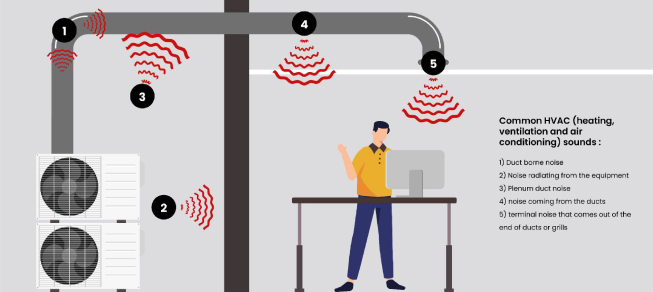
Here are common HVAC sounds: 1) Duct borne noise, 2) Noise radiating from the equipment, 3) Plenum duct noise, 4) noise coming from the ducts, and 5) terminal noise that comes out of the end of ducts or grills
Lighting design: The lighting design of a space can also impact the acoustical environment. Here are several ways lighting design affects acoustics:
- Sound absorption: The materials used for lighting fixtures, such as recessed ceiling lights or hanging pendants, can contribute to the absorption of sound. For example, fixtures made of fabric or other porous materials can help to absorb sound and improve the acoustic environment of the space, while recessed or surface-mounted fixtures that are flush with the ceiling can create a reflective surface that can contribute to unwanted echoes and reverberation. Pendant fixtures that hang from the ceiling can help to break up these reflections and reduce unwanted echoes.
- Reflection: Lighting fixtures can also contribute to the reflection of sound within a space. Fixtures with smooth and reflective surfaces, such as metal or glass, can reflect sound waves and create unwanted echoes and reflections.
- Placement: The placement of lighting fixtures can also affect the acoustics within a space. Fixtures placed directly above reflective surfaces, such as hard floors or tables, can create strong reflections and echoes. Fixtures placed above absorbent surfaces, such as carpets or drapes, can help to reduce reflections and improve the acoustic environment.
In summary, it’s worth noting that achieving sound comfort is a complex task that requires the consideration of many factors, including the space dimension, construction methods used to build the space, and the acoustical properties of the materials used within the space, among others. Ultimately, each space will have specific requirements, inclusive of goals and strategies, based on the use of the space, who the occupants will be, and what the acoustic goals are, if they exist.
See Other MODULES:


Join Our Community of Designers and Architects
Register below for your Trade Account and get your samples for free.